Grace Activities
1. An act of service expressing grace
If grace is an act…then to whom and in what way can you act with those around you. A very challenging place to start is to select three people—An immediate, a distant and an obscure person. Do some very small act of grace. Then watch what happens. Your actions have ABSOLUTELY NO EXPECTATION OF RECIPROCAL RESPONSE OR PRE CONDITION…So it doesn’t’ matter what they do as a response.
Now to each—act in grace. Maybe to your spouse extend to them a token which THEY have always wanted (Take note it is not to be what you have wanted for them…) Get up early and clean the bathroom on a Friday morning—if that is a chore that your spouse usually does on Saturday. Take out the trash…bring home a scented candle. Let them be both surprised, pleased, (and maybe slightly suspicious).
Similarly, to the distant associate—the neighbor, work colleague or distant cousin. Send a note (even, shock of all shocks, send it through the mail)! Recall a funny event…Express gratitude. Then watch what happens—first to you and then to them.
Finally, to that obscure person—Pay it forward. While you are in line at Chick Fil A or McDonalds—ask how much the order is for the car behind you and pay it! Then drive away. Do the same at the toll booth (Unless everyone is using transponders then this doesn’t work.) In essence, become that quintessential Boy or Girl Scout who walks the elderly across the street (preferably because they want to go that direction).
Finally, share your gifts with your spouse in the form of conversation. Become livened by doing good—then talk about what you did…
Note to self—when your spouse speaks of their acts of grace—you must act graciously as you discuss it. You, me, him or her are not experts as being gracious. Our acts will be, at times, woefully inadequate. But remember—always praise the beginner! Become enthusiastic towards the novice. Encourage the apprentice. From our music teachers, we all received “Gold Stars” on them as we mastered “Mary had a little lamb”. To them we had the makings of becoming someone great! Even with their praise, it was difficult. Without their praise we would give up.
2. Reflect and Observe our Anti-Grace…
Graciousness is not who we are, naturally. Grace is the opposite of our ordinary human response. It contradicts our senses and our initial shielding defenses. Our guarded self-protected logic tells us that the only way to have control is to take control. The only way to get your way is to insist upon it. The natural law of the jungle or the law of the city is not gracious; it is carnivorous. Only the strong survive. Maybe not “Win at all costs” as that sounds to self-fish…just win. Grace dares us to go against all that is self-protective. It is like the person who decides to master parachuting. The joke is, “Why would anyone want to jump out of a perfectly good airplane?” To leap is to act opposite of your natural defensive senses. In similar ways, Grace is the opposite of that defense response. But unlike the parachutist who leaps without reason. Grace is actually thoughtful, reasonable and sensible. Individuals act with grace in marriage to alter the pattern of pain—defense that maintains the cycle of relational conflict.
As an example, consider the chart below. Imagine you experience the hurts described in column A. Then image the natural response that you might demonstrate when those hurts occur (B) and their reaction (C). We have offered possible defensive and gracious responses. We encourage you to consider other gracious responses that might be possible. Here is an example:
A] Hurtful event: Your spouse forgets something important to you (like a birthday gift).
B] Your Natural Defensive Response: Disappointed, angered, neglected, abandoned
C] Their Anticipated Response to Your Defense: Justification, rationalization, minimization, denial, superficial apology
D] Your Gracious Response as a Substitute for Your Defensive Response: You remind the person kindly of the forgotten birthday gift.
E] Their Potential Response to Your Grace: Gratitude
Grace is difficult because it requires putting aside your “rights” with an attitude of humility. Humility dissolves walls of defensiveness. People are approachable when they are humble. The proud, the arrogant and the self-sufficient remain isolated from need, and from one another. The humble effects of grace acknowledge that you and I are not good enough to receive the gifts of trust, affection, and intimacy from our companion. Grace denounces the declaration “I am better than you”. Grace acknowledges that both partners are undeserving, neither are good enough. And they cannot be good enough.
When grace is introduced, the most beautiful and intimate of stories can emerge. Grace shows a raw beauty, purity, and power to cleanse and to heal. When grace is displayed amidst the grubbiness of marital conflict, the demonstration of a transformation can emerge. Self-centeredness and self-defensiveness pummel the US of our relationship. When a couple stands against such forces and gives grace to each other, it is the most an elegant transformation of the relationship.
Now, here is the same chart as above—only left blank. Hmmm, what might one do with it? (See, you don’t even have to be told how to learn to be gracious…you know it intuitively!)
A] Hurtful event:
B] Your Natural Defensive Response:
C] Their Anticipated Response to Your Defense:
D] Your Gracious Response as a Substitute for Your Defensive Response:
E] Their Potential Response to Your Grace:
3. Mapping Grace onto the Pain-Defense Model
Grace’s Effect
OK, let’s remind ourselves how we got here…There is pain within each of our life experiences. Some much more than others, but no one has had a painless existence. Pain leaks. It effects the space between people. Pain often comes to us from others—their intentional or accidental disregard or dismissiveness. Sometimes pain doesn’t come from people at all—as in the blind man of whom Jesus was asked, “Who sinned, this person or his parents?” In other words—Jesus, where did this mains pain come from? His answer, neither. It was not a single persons fault, but the result of life in a fallen world.
Pain will make us small—that is petty, defensive. It makes us self-absorbed, obsessed with the determined focus to eliminate it. Or pain makes us despair. We give up and become hopeless because we have not power to overcome it, or even minimize it.
Then there is grace
Grace contains our pain and creates an alternative to our defensiveness. Return to the cycle of conflict. The image is below. We have argued that conflict begins with the presence of pain and that pain’s existence demands that each of us act in its defense. The self-protection that pain provokes is usually constructed to limit access to all who might draw close and exacerbate our vulnerability. Pain and its defenses sets in motion a chain of responses and interpretations that perpetuate a cycle of injuries and subsequent defenses. The result is that we build emotional barriers with those whom we share intimate commitments. We hurt and distance those with whom we are closest, and with whom we have promised to manage the challenges of life together. It is here that grace can enter.
Pain, Hope, Defense, Offense and Grace Model below
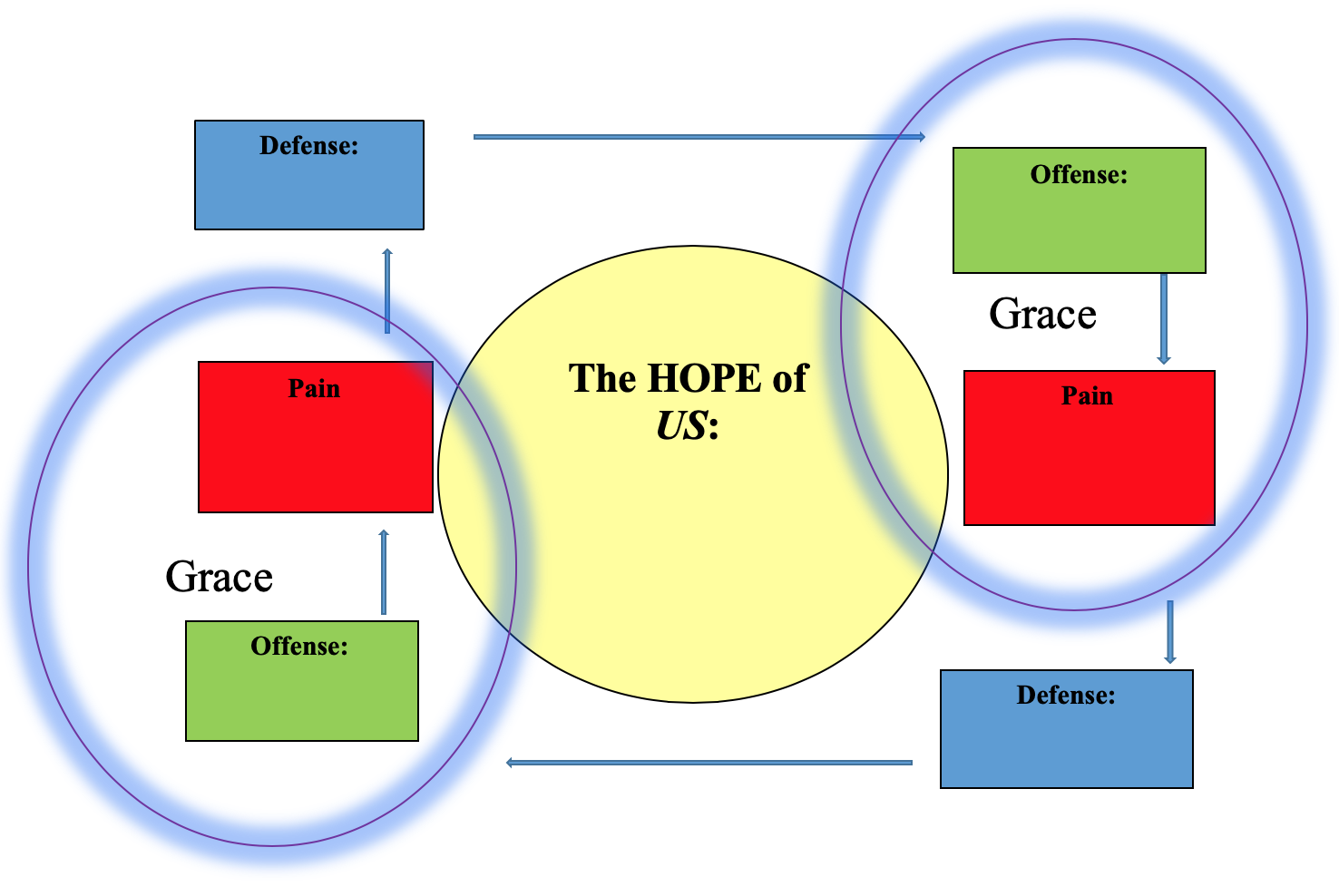
Grace covers our pain at times when we are most vulnerable. Grace surrounds it and contains it. Marital grace draws near to the pain of another when all signals scream “run away!” It is not easy to walk closely with your partner as they fight depression, or grief, or bitterness or a host of other painful issues. Paul Tournier, the eminent Swiss physician who wrote extensively about courageous living, explained how difficult grace is: “We need to see that universal sickness, that innumerable throng of men and women laden down with their secrets, laden down with their fears, their sufferings, their sorrows, their disappointments, and their guilt. [This is his description of our pain.] We need to understand how tragically alone they find themselves [Here is our defense in response to pain.]. . . Yet what eats away at them from within is that they may live years without finding anyone in whom they have enough confidence to unburden themselves (p. 49).”
Grace shares that burden. But it must do so through a path that leads away from the necessity of defenses, not towards them. Marital grace is disarming--it encourages the lowering of defenses and opens wide the possibility of intimacy because it declares that you are a safe lover, one who is committed to heal in the place of hurt and injury.
Watch the scene from Les Miserables where the priest gives grace to Jean Valjean and reflect on forgiveness. Watch video:
Now take just 3 minutes as a group to watch an illustration of grace from Les Misérables:© Copyright Grace Together